My Dissertation
From Rhetoric to Rule: Anti-Gender Political Discourse, Illiberal Governance, and Counterpublic Contestation in Post-1989 Poland
Over the past decade, so-called “anti-gender” campaigns have emerged as a transnational political force seeking to entrench traditional understandings of gender and sexuality as rooted in natural law, biology, religious doctrine, and social order. In places like Hungary, Poland, Brazil, Mexico, Uganda, and the United States, gender and sexuality have become charged frames through which broader anxieties about globalization, sovereignty, secularism, and democratic authority are articulated and condensed. Focusing on Poland as a particularly revealing site of post-communist transformation, my dissertation asks how “gender ideology” became such a politically effective symbolic enemy, how anti-gender discourse accumulated moral, affective, and political power over time, and why it has proven so effective as a vehicle for right-wing populist mobilization and democratic backsliding. Rather than treating the anti-gender movement as a singular or stable ideology, I understand it as a coalitional formation that brings together right-wing populists, nationalist actors, and conservative religious advocates through a shared investment in reframing gender as a civilizational threat. I approach anti-gender discourse not simply as a collection of erroneous or incoherent beliefs, but as a politically productive discursive formation that organizes social grievances and historical anxieties under the banner of a single phantasmatic enemy.
I argue that understanding anti-gender politics requires revisiting the uneven democratic transformations that followed the collapse of state socialism in Poland. The first part of the dissertation traces the rhetorical terrain of Poland’s post-1989 transition, examining how debates surrounding democracy, family, gender, sexuality, and national identity were negotiated through constitutional struggles, the negotiation of Catholic institutional authority, the implementation of neoliberal reforms, and competing visions of democratic belonging. Through a feminist rhetorical genealogy of political discourse, policy debates, media coverage, pastoral letters, activist texts, and public pedagogical materials, I show how anti-gender mobilization does not emerge as an abrupt ideological rupture, but as a development rooted in unresolved tensions within Poland’s post-socialist transformation. Particular attention is given to the symbolic inheritance of Solidarność, the re-entrenchment of traditional moral frameworks, and the ways material gains toward gender equality achieved during the socialist period were rhetorically reframed as artificial impositions rather than social achievements.
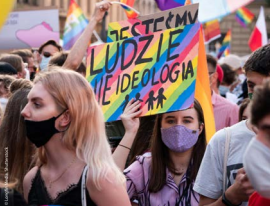
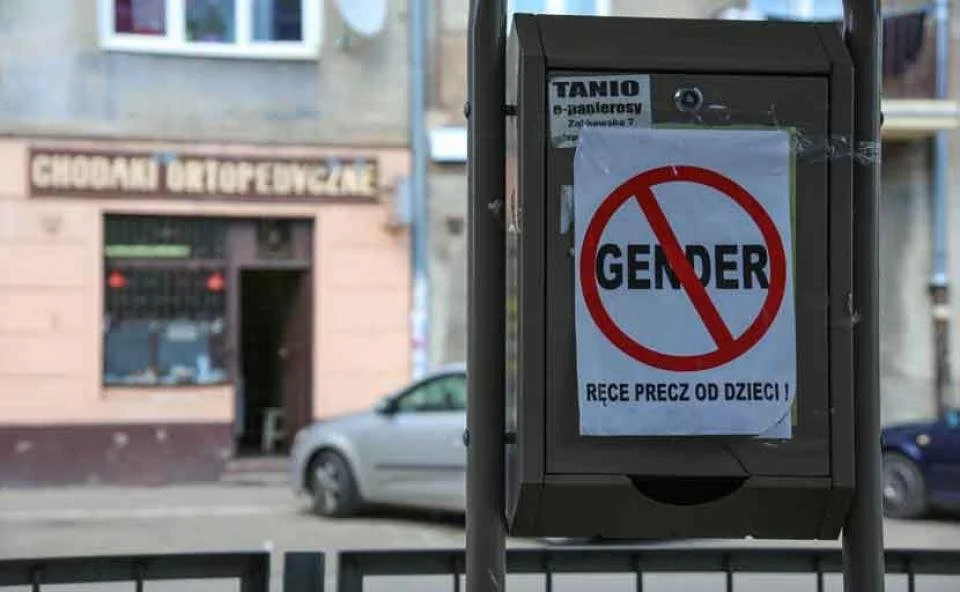
The second part of the dissertation examines “gender ideology” as a rhetorical and symbolic formation that condenses moral anxiety, historical grievance, and political antagonism into a single emotionally charged object of opposition. Drawing on Althusser’s understanding of ideology, Laclau and Mouffe’s theory of articulation and empty signifiers, and Judith Butler’s account of the “phantasm of gender,” I analyze how anti-gender rhetoric organizes political imagination through narratives of invasion, contamination, moral decline, and national defense. Through close readings of political speeches, Catholic pastoral messaging, media campaigns, activist discourse, and visual rhetoric, I examine how queer and feminist communities are portrayed as simultaneously powerless and dangerously omnipotent, allowing diffuse anxieties surrounding globalization, democratic change, and cultural transformation to crystallize around a singular symbolic enemy. Rather than explaining the success of anti-gender mobilization through ignorance or misinformation alone, I argue that its persuasive force lies in its capacity to organize fear, nostalgia, grievance, and moral certainty into a compelling political imaginary.
The third part of the dissertation considers how anti-gender discourse becomes translated into governance and institutional transformation. Focusing on the consolidation of power under Law and Justice (PiS), I examine how narratives surrounding gender and sexuality become embedded within increasingly authoritarian projects through abortion legislation, LGBTQ-free zone declarations, educational reform, media consolidation, and attacks on universities and NGOs. I argue that anti-gender politics functions not merely as cultural backlash, but as an infrastructural technology of governance that reorganizes democratic life from within while preserving the formal appearance of democratic procedure. In this sense, anti-gender rhetoric does not simply accompany democratic erosion; it facilitates the conditions through which such erosion becomes normalized.
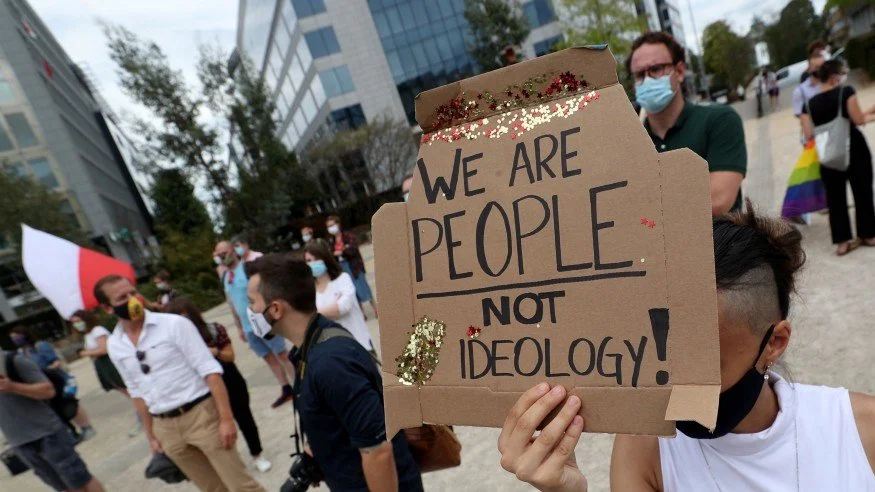
The final part of the dissertation turn an investigation of feminist and queer counterpublic practices (in a simultaneous effort to problematize the concept of the counterpublic), examining how activists mobilize music, poetry, zines, protest symbolism, performance, and grassroots cultural production to cultivate alternative public spheres and sustain collective resistance under conditions of backlash. Drawing on archival research, interviews, and cultural analysis, I examine these practices not merely as forms of artistic resistance, but as rhetorical technologies of imagination through which activists rehearse alternative modes of democratic belonging, care, survival, and solidarity. By tracing both the construction of anti-gender rhetoric and the creative practices that contest it, the project explores how democratic imagination might be reclaimed under conditions of backlash — and what forms of solidarity become possible when politics is framed not only as war, but as care.